INDIE GAMES

Adelaide Remake

Back Alley Tale

Touch It Rikka

Yamanes Love Life
EXCLUSIVE GAMES

Fredina Nights Club

Minesters Touch It Rikka

My Dystopian Robot Girlfriend

Sloven Classmate


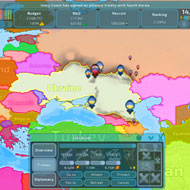


In Dummynation you start with a single country, a modest GDP, and one condition standing between you and victory: control more than half of the world’s total GDP before anyone else does. Everything else — budgets, diplomacy, war — exists to serve that one number.
| Genre | Geopolitical strategy simulation |
| Win condition | Over 50% of world GDP |
| Modes | Single-player, battle royale, coalition multiplayer, custom scenarios |
Unlike a lot of grand strategy games, Dummynation doesn’t tie resources to entire provinces. Instead, resources are inherent to each specific point on the map, and when you conquer new land, those individual points and whatever they produce get annexed progressively over time rather than all at once. Practically, that means you can attack a country and start extracting value from the border regions almost immediately, while the interior takes longer to fully absorb — conquest speed is noticeably slower when it starts deep inside a country rather than near its edge.
You expand mainly through the attack button, sending a troop squad against any country you share a border or sea access with. Once that squad is stationed and unopposed for a while, it gradually gains control of the area, converting captured resources into your own. If you’d rather not swallow a whole country, you can draw a specific region on the map instead of using the standard attack, letting you carve out exactly the territory you want.
Running a country in Dummynation comes down to a handful of budget sliders that all pull from the same pool. Social spending improves quality of life, lowers mortality, and raises birth rates and immigration — its impact scales with GDP per capita, so it matters more once your economy is already strong. Research funding generates research points you can spend at any time on unlockable bonuses, and a portion of your budget can be deposited into a public treasury, where it’s kept in a wealth fund that grows with the global economy but can also lose value during downturns.
Players optimizing for a strong long game tend to keep research funding in the 6–8% range and military spending closer to 5–8%, since overspending on any one category leaves your land impoverished and puts you behind in the overall balance of power.
Manipulating diplomatic relations is central to Dummynation, and the most common beginner mistake is attacking without checking how a target country’s diplomacy compares to your own first. Rushing a nearby country because it’s convenient, rather than because the diplomatic math favors you, tends to create powerful enemies faster than your military can handle. Community advice generally steers new players toward allying with stable, less contentious nations early on, while avoiding countries that already carry a lot of existing enemies, since friendliness toward them can drag those conflicts onto you as well.
Choosing a starting country also matters more than it looks. Countries rated as higher difficulty tend to actually be weaker in raw power, which paradoxically makes them harder to win with rather than easier, since you have less room for early mistakes. New players are generally better off picking a lower-difficulty, more stable starting nation while they learn the budget and diplomacy systems.
Victory goes to the first country to control more than half of the world’s total GDP, tracked through the ranking interface, which shows your progress alongside every other country’s economic standing.
New players generally do better picking a lower-difficulty country, since higher-difficulty ratings actually indicate weaker starting positions that are harder to recover from if early diplomacy or budget decisions go wrong.
Diplomatic relations directly affect how safely you can attack or ally with another country, and comparing your diplomacy standing against a target before declaring war is one of the most repeated pieces of community advice for avoiding unnecessary enemies.
Between the point-based resource system, the treasury’s wealth fund, and the sheer number of ways a coalition can lock its members into a shared win condition, Dummynation turns the abstract goal of world GDP dominance into a genuinely tangled set of choices every single session.